Prof Richard Price
| Research Area: | Global Health |
|---|---|
| Scientific Themes: | Tropical Medicine & Global Health |
| Keywords: | malaria, epidemiology, drug resistance and clinical trials |
The main focus of our research programme is to rationalise the control of drug resistant Plasmodium vivax by improving strategies to optimise its surveillance and management. To achieve this we are: i) defining the burden of vivax malaria in South East Asia with particularly attention to areas where chloroquine resistance is emerging, ii) conducting clinical studies to optimise the prevention and treatment of vivax malaria iii) developing ex vivo tools to improve the surveillance and characterisation of drug resistance in P. vivax and iv) evaluating the impact and cost effectiveness of widespread deployment of artemisinin combination therapies on malaria related morbidity and mortality.
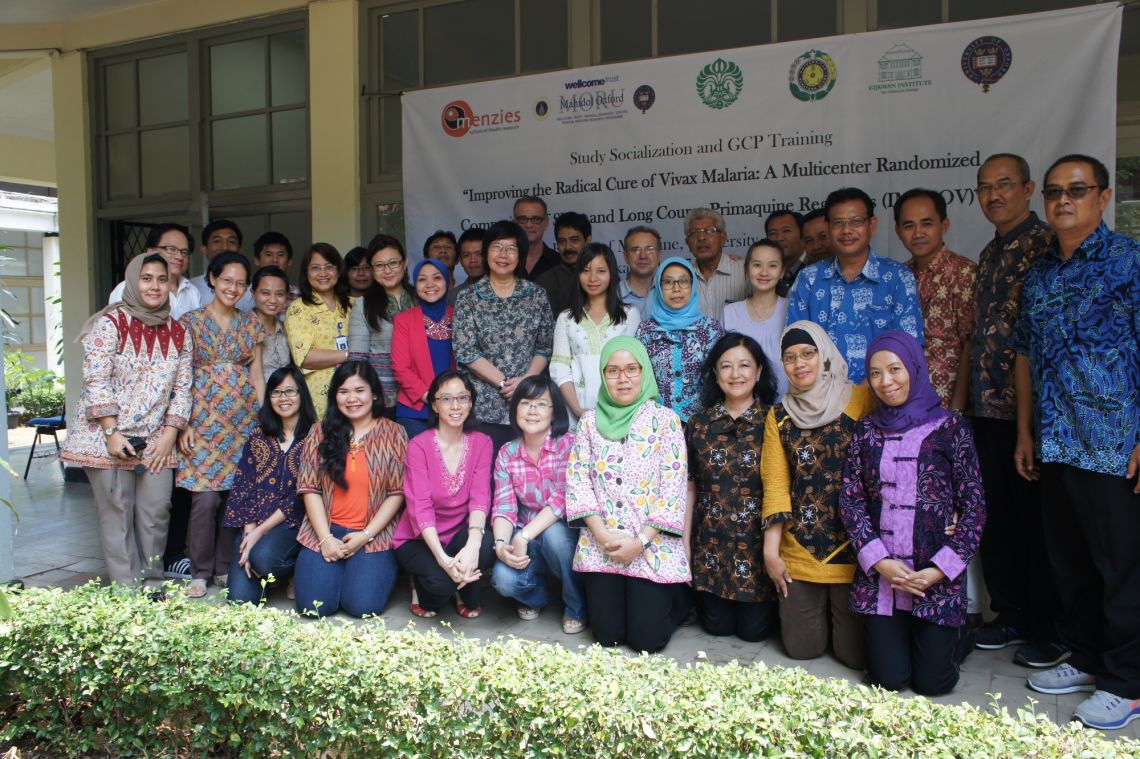
The programme is being conducted in collaboration with the Mahidol Oxford Research Unit (MORU) in Thailand and the Menzies School of Health Research (MSHR) in Darwin, with partners in the Indonesian Ministry of Health. Our field site in Papua currently employs 15 full time staff, with a research agenda that spans epidemiology, health economics, clinical trials, pathophysiology, immunology, in vitro studies and molecular biology.
Current Projects:
- Epidemiology studies of chloroquine resistant P. vivax.
- Clinical trials of new treatments for drug resistant malaria.
- Molecular and in vitro studies to characterise drug resistance in P. falciparum and P. vivax.
- Impact and cost effectiveness studies of artemisinin combination therapy for drug resistant P. falciparum and P. vivax in Papua, Indonesia.
| Name | Department | Institution | Country |
|---|---|---|---|
| Nicholas Anstey | International Health Division, Menzies School of Health Research | Australia | |
| David Fidock | Columbia University, NYC | USA | |
| Tim ANDERSON | Southwest Foundation Texas | USA | |
| Qin Cheng | Australian Malaria Institute, Brisbane | Australia | |
| Julie Simpson | Melbourne University | Australia | |
| Emiliana Tjitra | National Institue of Health Research and Development | Indonesia |
2011. Plasmodium vivax recurrence following falciparum and mixed species malaria: risk factors and effect of antimalarial kinetics. Clin Infect Dis, 52 (5), pp. 612-620. Read abstract | Read more
Plasmodium vivax malaria commonly follows treatment of falciparum malaria in regions of co-endemicity. This is an important cause of preventable morbidity. Hide abstract
2010. Artemisinin combination therapy for vivax malaria. Lancet Infect Dis, 10 (6), pp. 405-416. Read abstract | Read more
Early parasitological diagnosis and treatment with artemisinin-based combination therapies (ACTs) are key components of worldwide malaria elimination programmes. In general, use of ACTs has been limited to patients with falciparum malaria whereas blood-stage infections with Plasmodium vivax are mostly still treated with chloroquine. We review the evidence for the relative benefits and disadvantages of the existing separate treatment approach versus a unified ACT-based strategy for treating Plasmodium falciparum and P vivax infections in regions where both species are endemic (co-endemic). The separate treatment scenario is justifiable if P vivax remains sensitive to chloroquine and diagnostic tests reliably distinguish P vivax from P falciparum. However, with the high number of misdiagnoses in routine practice and the rise and spread of chloroquine-resistant P vivax, there might be a compelling rationale for a unified ACT-based strategy for vivax and falciparum malaria in all co-endemic regions. Analyses of the cost-effectiveness of ACTs for both Plasmodium species are needed to assess the role of these drugs in the control and elimination of vivax malaria. Hide abstract
2009. Vivax malaria: a major cause of morbidity in early infancy. Clin Infect Dis, 48 (12), pp. 1704-1712. Read abstract | Read more
In areas where malaria is endemic, infants aged <3 months appear to be relatively protected from symptomatic and severe Plasmodium falciparum malaria, but less is known about the effect of Plasmodium vivax infection in this age group. Hide abstract
2008. Amplification of pvmdr1 associated with multidrug-resistant Plasmodium vivax. J Infect Dis, 198 (10), pp. 1558-1564. Read abstract | Read more
Multidrug-resistant strains of Plasmodium vivax are emerging in Southeast Asia. Hide abstract
2008. Multidrug-resistant Plasmodium vivax associated with severe and fatal malaria: A prospective study in Papua, Indonesia PLOS MEDICINE, 5 (6), pp. 890-899. | Read more
2008. Adverse pregnancy outcomes in an area where multidrug-resistant plasmodium vivax and Plasmodium falciparum infections are endemic. Clin Infect Dis, 46 (9), pp. 1374-1381. Read abstract | Read more
Plasmodium falciparum infection exerts a considerable burden on pregnant women, but less is known about the adverse consequences of Plasmodium vivax infection. Hide abstract
2008. Determinants of in vitro drug susceptibility testing of Plasmodium vivax. Antimicrob Agents Chemother, 52 (3), pp. 1040-1045. Read abstract | Read more
In Papua, Indonesia, the antimalarial susceptibility of Plasmodium vivax (n = 216) and P. falciparum (n = 277) was assessed using a modified schizont maturation assay for chloroquine, amodiaquine, artesunate, lumefantrine, mefloquine, and piperaquine. The most effective antimalarial against P. vivax and P. falciparum was artesunate, with geometric mean 50% inhibitory concentrations (IC50s) (95% confidence intervals [CI]) of 1.31 nM (1.07 to 1.59) and 0.64 nM (0.53 to 0.79), respectively. In contrast, the geometric mean chloroquine IC50 for P. vivax was 295 nM (227 to 384) compared to only 47.4 nM (42.2 to 53.3) for P. falciparum. Two factors were found to significantly influence the in vitro drug response of P. vivax: the initial stage of the parasite and the duration of the assay. Isolates of P. vivax initially at the trophozoite stage had significantly higher chloroquine IC50s (478 nM [95% CI, 316 to 722]) than those initially at the ring stage (84.7 nM [95% CI, 45.7 to 157]; P < 0.001). Synchronous isolates of P. vivax and P. falciparum which reached the target of 40% schizonts in the control wells within 30 h had significantly higher geometric mean chloroquine IC50s (435 nM [95% CI, 169 to 1,118] and 55.9 nM [95% CI, 48 to 64.9], respectively) than isolates that took more than 30 h (39.9 nM [14.6 to 110.4] and 36.9 nM [31.2 to 43.7]; P < 0.005). The results demonstrate the marked stage-specific activity of chloroquine with P. vivax and suggest that susceptibility to chloroquine may be associated with variable growth rates. These findings have important implications for the phenotypic and downstream genetic characterization of P. vivax. Hide abstract
2007. Two fixed-dose artemisinin combinations for drug-resistant falciparum and vivax malaria in Papua, Indonesia: an open-label randomised comparison. Lancet, 369 (9563), pp. 757-765. Read abstract | Read more
The burden of Plasmodium vivax infections has been underappreciated, especially in southeast Asia where chloroquine resistant strains have emerged. Our aim was to compare the safety and efficacy of dihydroartemisinin-piperaquine with that of artemether-lumefantrine in patients with uncomplicated malaria caused by multidrug-resistant P falciparum and P vivax. Hide abstract
2006. Molecular and pharmacological determinants of the therapeutic response to artemether-lumefantrine in multidrug-resistant Plasmodium falciparum malaria. Clin Infect Dis, 42 (11), pp. 1570-1577. Read abstract | Read more
Our study examined the relative contributions of host, pharmacokinetic, and parasitological factors in determining the therapeutic response to artemether-lumefantrine (AL). Hide abstract
2004. Mefloquine resistance in Plasmodium falciparum and increased pfmdr1 gene copy number. Lancet, 364 (9432), pp. 438-447. Read abstract | Read more
The borders of Thailand harbour the world's most multidrug resistant Plasmodium falciparum parasites. In 1984 mefloquine was introduced as treatment for uncomplicated falciparum malaria, but substantial resistance developed within 6 years. A combination of artesunate with mefloquine now cures more than 95% of acute infections. For both treatment regimens, the underlying mechanisms of resistance are not known. Hide abstract
2000. Effects of artesunate-mefloquine combination on incidence of Plasmodium falciparum malaria and mefloquine resistance in western Thailand: a prospective study. Lancet, 356 (9226), pp. 297-302. Read abstract | Read more
Worsening drug resistance in Plasmodium falciparum malaria is a major threat to health in tropical countries. We did a prospective study of malaria incidence and treatment in an area of highly multidrug-resistant P. falciparum malaria. Hide abstract
1996. Effects of artemisinin derivatives on malaria transmissibility. Lancet, 347 (9016), pp. 1654-1658. Read abstract | Read more
On the western border of Thailand the efficacy of mefloquine in the treatment of falciparum malaria has declined while gametocyte carriage rates have increased, which suggests increased transmissibility of these resistant infections. We compared the following antimalarial drugs in relation to subsequent Plasmodium falciparum gametocyte carriage: mefloquine, halofantrine, quinine, and the artemisinin derivatives. Hide abstract